 how-to
Hire a Website Automation Consultant: 2026 Guide
Table of Contents
- What a Website Automation Consultant Actually Does
- How to Evaluate an Automation Consultant Before You Hire
- Marketing Automation Consulting Rates: What to Expect
- Business Process Automation Tools Your Consultant Should Know
- Automation Strategy for Small Business: Scope and Priorities
- Freelance Marketplace vs. Consulting Firm: Choosing the Right Engagement Model
- ROI Calculation and Post-Implementation Maintenance
- Conclusion
Last Updated: August 20, 2026
What a Website Automation Consultant Actually Does
A website automation consultant identifies manual, repetitive processes across your digital operations and replaces them with automated workflows that reduce human error, cut overhead, and produce measurable performance outcomes. This is not a web designer who adds a chatbot, the scope is considerably deeper.
The actual work involves process mapping your existing operations, identifying integration gaps between systems like CRM, scheduling platforms, and reporting dashboards, then designing and implementing automated workflows that connect those systems without constant human intervention.
A qualified automation consultant typically handles business process automation, API integration, marketing automation, test automation, and legacy system modernization. The distinction that matters most: a good automation consultant doesn't just configure software. They translate your business logic into technical specifications, then build systems that enforce that logic automatically. If your team is manually exporting data from one platform and importing it into another, that's a solvable integration problem. The right consultant closes that gap.
How to Evaluate an Automation Consultant Before You Hire
Most hiring decisions for technical consultants go wrong at the evaluation stage. Organizations assess communication style and portfolio aesthetics when they should be probing technical depth and implementation track record.
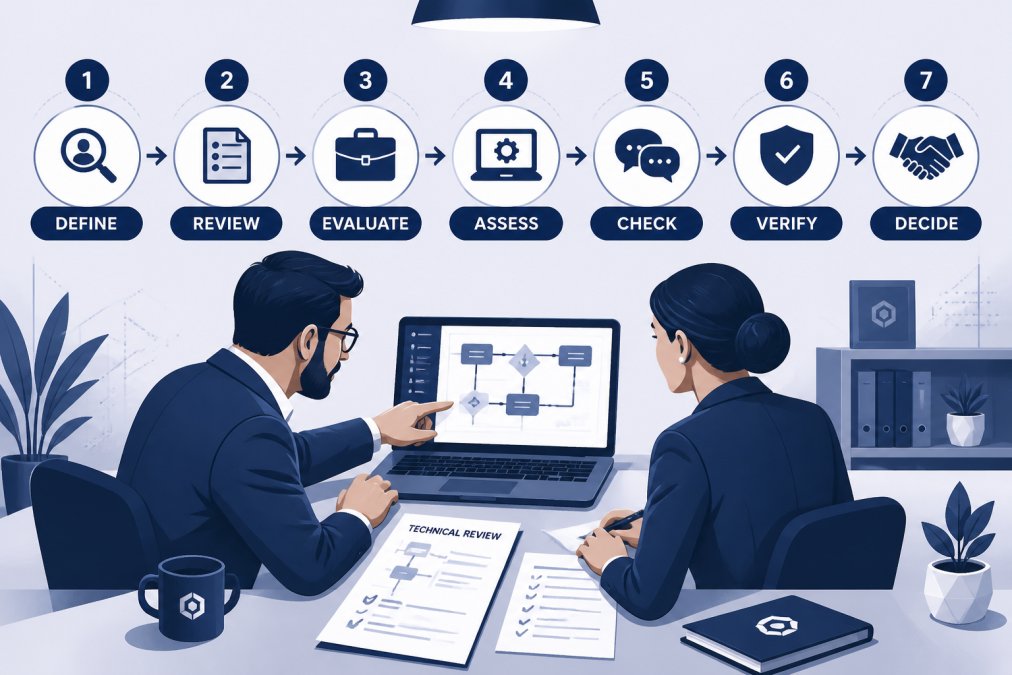
The first filter is specificity. Ask any candidate to walk you through a recent implementation: which systems were connected, what the data flow looked like, how exceptions were handled, and what broke during testing. Vague answers reveal surface-level experience. Practitioners describe edge cases and failure modes because they've encountered them.
Vetting Technical Stack Proficiency
Your consultant needs demonstrated experience with the specific tools in your environment, not just general familiarity with "automation platforms." If you're running Salesforce, HubSpot, and a custom scheduling tool, your candidate should describe how they'd architect the data flow between those systems, what API limitations they'd anticipate, and how they'd handle authentication and rate limiting.
Key technical areas to probe: API integration patterns, data migration methodology, cloud infrastructure familiarity, automation framework selection, and custom software development scope. Ask for a brief technical scoping document as part of the evaluation. Candidates who can produce a clear, accurate scoping document for your environment within a short discovery call are demonstrating exactly the analytical capability you need.
Canadian Data Sovereignty and PIPEDA Compliance
Any automation workflow that processes personal information about Canadian residents must comply with the Personal Information Protection and Electronic Documents Act (PIPEDA). This has direct implications for how your consultant designs data flows, where data is stored, and how long it's retained.
Specific risks in automation contexts include cross-border data transfers that trigger PIPEDA's accountability provisions, data minimization requirements, and audit trail documentation. As of 2025, Canada's federal government has been advancing Bill C-27, which would replace PIPEDA with the Consumer Privacy Protection Act. According to Canada's Office of the Privacy Commissioner, organizations should build compliance frameworks now that can accommodate anticipated changes. A consultant who can't speak to data sovereignty in concrete terms is a liability, not an asset.
Marketing Automation Consulting Rates: What to Expect
Marketing automation consulting rates vary considerably based on engagement model, scope complexity, and the consultant's specialization depth. Broadly, the market segments into three tiers:
| Engagement Type | Typical Structure | Best For |
|---|---|---|
| Freelance specialist | Project-based or hourly | Defined, contained integrations |
| Boutique consultancy | Retainer or fixed-scope | Ongoing optimization and strategy |
| Full-service agency | Multi-phase engagements | Enterprise-scale digital transformation |
Pricing is driven by the number of systems being integrated, whether custom software development is required, the volume and sensitivity of data being processed, and post-implementation support expectations. For accurate marketing automation consulting rates relevant to your project, contact Concierge Brokers directly for a scoped estimate.
Business Process Automation Tools Your Consultant Should Know
A capable automation consultant doesn't advocate for a single platform. They select tools based on your requirements. Your consultant should have hands-on experience with workflow orchestration platforms, CRM integration middleware, marketing automation platforms, and AI-driven workflows.
According to Gartner's research on hyperautomation trends, organizations that approach automation as a strategic capability rather than a collection of point solutions see substantially better operational outcomes. The practical question to ask any candidate: "Walk me through how you'd evaluate which automation framework to use for our environment." The answer reveals whether they're a platform advocate or a genuine technical advisor.
Automation Strategy for Small Business: Scope and Priorities
Automation strategy for small business looks different from enterprise implementations. Start with the single most painful manual process and build outward from there. Trying to automate everything at once is how small teams end up with partially configured systems that nobody trusts.
A practical prioritization framework: identify the highest-frequency manual task, map the data flow before touching any tooling, confirm system access and API availability, build a minimum viable automation that handles the standard case, then add exception handling in a second phase. Document the workflow before moving to the next automation.
Change management is underrated in small business automation contexts. The most technically sound workflow fails if the team doesn't trust it or understand when to intervene. Design automations that can handle 3-5x your current volume without rearchitecting. The cost difference at build time is minimal; the cost of rebuilding at growth time is significant.
Freelance Marketplace vs. Consulting Firm: Choosing the Right Engagement Model
The freelance vs. consulting firm decision comes down to risk tolerance, project complexity, and how much internal capacity you have to manage an external engagement.
Freelance marketplaces give you access to many specialists at competitive rates. The trade-off is coordination overhead and accountability gaps. Consulting firms offer structured engagements with defined deliverables, service level agreements, and institutional continuity.
| Scenario | Recommended Model |
|---|---|
| Single integration, well-defined scope | Freelance specialist |
| Multi-system implementation with data sensitivity | Consulting firm |
| Ongoing optimization and strategic advisory | Retainer with boutique consultancy |
| Internal team with technical capacity, needs oversight | Technical advisory engagement |
| No internal technical capacity | Full-service consulting firm |
The engagement model should match your internal capacity, not just your budget. A consulting firm engagement where your team can't participate in knowledge transfer creates dependency. A freelance engagement where your team lacks the technical background to evaluate the work creates a different kind of risk. Full-time recruitment is usually the wrong answer, automation projects are intensive at implementation and lighter afterward.
ROI Calculation and Post-Implementation Maintenance
ROI for automation projects is calculable, but most organizations measure it incorrectly by focusing on cost savings and ignoring value creation.

A cost-benefit analysis should account for direct cost savings, error reduction value, throughput gains, and time-to-value on new processes. According to McKinsey's research on automation and productivity, organizations that measure automation ROI comprehensively, including throughput and quality improvements rather than just labor savings, consistently identify higher returns than their initial projections anticipated.
Post-implementation maintenance is where many automation projects quietly fail. Automated workflows break when upstream systems change their APIs, when data formats shift, or when business logic evolves. A responsible consulting engagement includes documented monitoring and alerting for workflow failures, a defined process for handling exceptions, a scheduled review cadence to assess whether the automation still reflects current business logic, and clear ownership of the workflow post-handoff.
Fragmented digital tools and manual data entry are solvable problems, but only when the automation engagement is scoped, implemented, and maintained with genuine technical rigor. Concierge Brokers provides defensible system integration and workflow automation grounded in measurable performance outcomes, not surface-level configuration. Our focus on rigorous remediation means the systems we build withstand scrutiny when your CFO, CMO, or auditor asks for documentation. Get started with Concierge Brokers and replace manual overhead with automated workflows that deliver clarity across your digital operations.
Frequently Asked Questions
What does a website automation consultant do?
A website automation consultant analyzes your existing digital workflows, identifies manual bottlenecks, and designs systems that move data automatically between platforms such as your CRM, scheduling tools, and reporting dashboards. On the website side, this includes automating lead capture, form routing, and performance tracking. The goal is operational efficiency: your team stops doing repetitive data entry and starts acting on the outputs that automation surfaces.
How does PIPEDA compliance affect website automation?
Canada's Personal Information Protection and Electronic Documents Act (PIPEDA) governs how personal data is collected, stored, and transferred. When you automate workflows that touch contact forms, email sequences, or CRM records, every data handoff must meet PIPEDA's consent and storage requirements. A qualified automation consultant will map data flows, confirm that cloud infrastructure keeps personal data within Canadian jurisdiction where required, and document compliance decisions so your organization can demonstrate accountability to regulators.
What should be included in an automation consulting contract?
A solid contract covers project scope and deliverables, implementation timeline with defined milestones, a service level agreement for post-launch support, ownership of any custom code or automation frameworks built during the engagement, and data handling obligations under PIPEDA. It should also specify what happens if the project scope changes, how additional work is priced, and the handoff process so your internal team can maintain the system without depending on the consultant indefinitely.
How do I verify the credentials of an automation consultant?
Ask for documented case studies showing measurable outcomes, not just client logos. Request references from organizations with a comparable technical environment to yours. During the vetting process, ask the consultant to walk through how they would integrate your specific stack, for example Salesforce, HubSpot, or a custom scheduling tool. Certifications from major platform vendors add credibility, but the strongest signal is a consultant who can explain the business logic behind each automation decision, not just the technical steps.
This article was written using GrandRanker
Frequently Asked Questions
What does a website automation consultant do?
A website automation consultant analyzes your existing digital workflows, identifies manual bottlenecks, and designs systems that move data automatically between platforms such as your CRM, scheduling tools, and reporting dashboards. On the website side, this includes automating lead capture, form routing, and performance tracking. The goal is operational efficiency: your team stops doing repetitive data entry and starts acting on the outputs that automation surfaces.
How does PIPEDA compliance affect website automation?
Canada's Personal Information Protection and Electronic Documents Act (PIPEDA) governs how personal data is collected, stored, and transferred. When you automate workflows that touch contact forms, email sequences, or CRM records, every data handoff must meet PIPEDA's consent and storage requirements. A qualified automation consultant will map data flows, confirm that cloud infrastructure keeps personal data within Canadian jurisdiction where required, and document compliance decisions so your organization can demonstrate accountability to regulators.
What should be included in an automation consulting contract?
A solid contract covers project scope and deliverables, implementation timeline with defined milestones, a service level agreement for post-launch support, ownership of any custom code or automation frameworks built during the engagement, and data handling obligations under PIPEDA. It should also specify what happens if the project scope changes, how additional work is priced, and the handoff process so your internal team can maintain the system without depending on the consultant indefinitely.
How do I verify the credentials of an automation consultant?
Ask for documented case studies showing measurable outcomes, not just client logos. Request references from organizations with a comparable technical environment to yours. During the vetting process, ask the consultant to walk through how they would integrate your specific stack, for example Salesforce, HubSpot, or a custom scheduling tool. Certifications from major platform vendors add credibility, but the strongest signal is a consultant who can explain the business logic behind each automation decision, not just the technical steps.